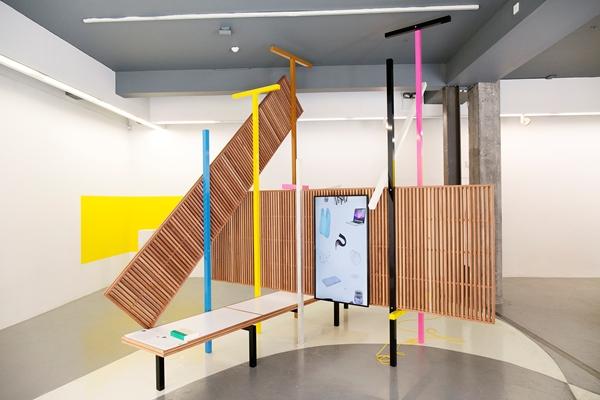
Group Occupation II 13 May - 4 August 2013 The New Art Gallery Walsall
In 2013 Extra Special People (ESP) and The New Art Gallery Walsall (TNAGW) teamed up to offer Group Occupation II, the second series of short, practical residencies for ESP members. Working in the Artists’ Studio at TNAGW, artists occupied the space in groups of three for six weeks at a time from May to August 2013. Group Occupation II provided artists with critical input, time and space within a mutually supportive group context in which they could develop new work. Artists were grouped together according to their practice, interests and approach to the residency, encouraging a useful dialogue and possibilities for working together to develop.
Group 1: Meghan Allbright, Beth Bramich & Andrew Lacon
Meghan Allbright
During her Group Occupation II residency artist Meghan Allbright developed a new body of sculptural work. While at TNAGW the public nature of the Artists’ Studio with its large window and the architecture and movements within the gallery impacted her making process. She began to feel that her activities were temporarily performative and her sculptural work started to be influenced by the spaces, materials and movements inside and outside the gallery.
The sculptures she developed came from an interest in the reflective materials- glass and plastic- used within the gallery as the method of both displaying and protecting the artworks. On spending time in the collections she realised that the characteristics of one or several contrasting artefacts positioned near to one another could be combined and mirrored in the same reflective plane. The pieces that resulted from this residency use Perspex, a material that is new to Allbright. She describes them as ‘fleeting, reflective collages’ that rely on reflections and movements; only when staged and viewed do they ‘perform’ as works.
Beth Bramich
Writer and curator Beth Bramich developed research for an essay on the changing social function of public art during her time in Walsall. A key figure to emerge in her work was Nicholas Munro’s ‘King Kong’, one of 16 sculptures erected as part of the City Sculpture Project in Birmingham in 1972.
In addition to using TNAGW’s art library and engaging in reading groups with co-residents to expand her references and debate some of the key issues around public art, she also attended a conference, ‘Good Things and Bad Things’ at Nottingham Contemporary and arranged a research trip to Wolverhampton Art Gallery to see the maquette of ‘King Kong’ and documentation of its public reception. Beth is currently working, with the support of Grand Union, Birmingham, to find a suitable publisher for both the essay and visual materials collected during the research process.
Andrew Lacon
During his Group Occupation residency Andrew continued his on going research into the relationship between photography and sculpture. Following on from a research residency at the Henry Moore Institute Leeds, where he started to look Into the documentation of sculpture within archives and the sculptors studio, Andrew used the residency to look at TNAGW’s archives and in particular the work of Geoffrey Ireland. Working from Ireland’s images of the sculptor Jacob Epstein, Andrew was interested in the way that they exist as both document and artwork and their shifting status within an archive and exhibition. During this residency Andrew also discovered an interest in colour, which he sees as a breakthrough in his practice.
This research further developed Andrew’s theoretical and studio practice. The work undertaken during the residency directly informed his proposal and show Agalmatophilia as part of the Figure One programme at Baltic 39 Newcastle in September 2013. This research has also formed a base for his recently awarded Wheatley Fellowship at BIAD where we will be developing new work around photography and sculpture during 2013/14.
Group 2: Carruthers & Cresswell, Chris Clinton & Anna Falcini
Carruthers & Cresswell
Collaborative duo Carruthers & Cresswell make work that creates dialogue around environmental concerns. During their Group Occupation residency they began a new body of work that would incite a discussion of the decline of bee populations. After much research, exploration and conversation, they initiated a series of abstract drawings from their own video footage of bees flying to and from a hive.
Carruthers & Cresswell’s work has a socially-engaged element and at Walsall they utilized the public space of the gallery to invite visitors to participate in a series of drawing exercises in which the artists let go of their authorship of the image to varying degrees. Alongside the drawings they made a new video work. These works were a departure from their previous sculptural collaborations. Carruthers & Cresswell showed the video at the ESP Summer Camp in August and will continue to develop both video and drawings.
Chris Clinton
Chris Clinton makes sculptural works that use the materials and motifs of popular culture. While at TNAGW he generated many new ideas and developed works that were mid-production at the start of the residency with the use of the gallery’s workshop. As well as continuing with his Dartboard works- a series that occupies the space between painting and sculpture- Clinton began to work with VHS tapes as sculptural material.
The works he made took a more site responsive approach both in terms of the structures used as a framework for the VHS tapes and in their interaction with the space of presentation. The stretched VHS tapes he experimented with create a lacquer-like surface that no longer stores the information needed to play a video but instead reflects an image of its surroundings back to the viewer. One of the pieces that resulted from residency utilizes a found market stall frame and the material of VHS tapes to reference Walsall’s town centre and the shift in function and status of everyday objects. Clinton will have a solo exhibition at TNAGW in 2014.
Anna Falcini
Artist Anna Falcini began her residency with a proposal to explore the interpretation of contemporary art in a public gallery. She was interested in the convergence between the audiences’ perceptions of contemporary art and a curatorial interpretation, where the language of interpretation is inherited from, the format it is presented in, the nuances of interpretation including how gallery staff convey their own interpretations of the work and how vernacular language is used in a public gallery.
Part of Falcini’s research took the form of impromptu interviews with curators, audience members, technical staff and gallery assistants. She spent time observing how visitors to the gallery responded to the work on display, listened to conversations, went into the archive of the TNAGW, looked at interpretation materials and generally became a constant observer of the way language exists in the gallery. An initial series of drawings that came out of this research were exhibited in September 2013 in the Mezzanine Case at TNAGW.